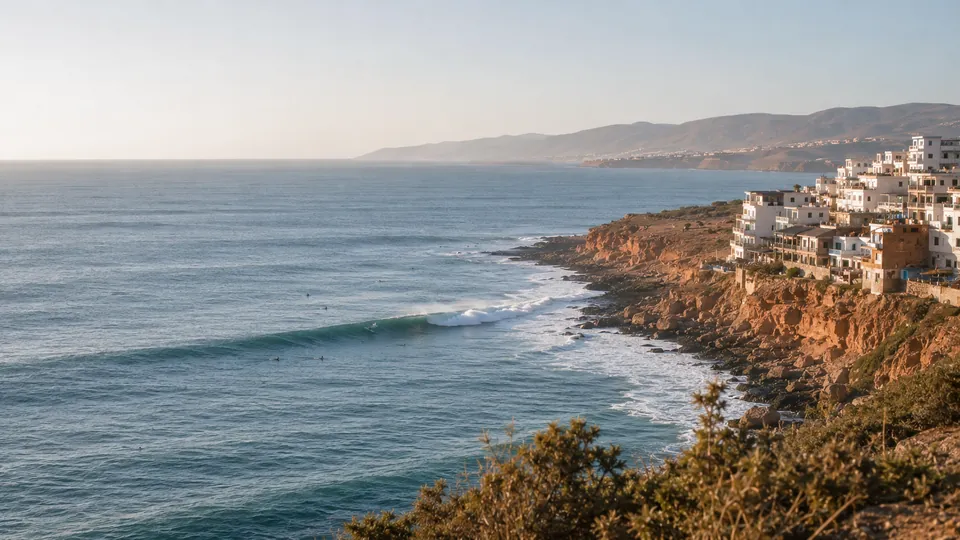
If you have only ever surfed Croyde or Fistral, Morocco will feel like a different sport. The water is warmer, the swell is more reliable, and the waves that made Taghazout famous break over rock. That last part is the one that catches people out.
The spots are not interchangeable
Three documented breaks around Taghazout, and one of them suits a beginner.
| Spot | Bottom | Level | Rating |
|---|---|---|---|
| Anchor Point | rocky point | advanced to expert | 4.9 |
| Boilers | reef | intermediate to advanced | 4.6 |
| Banana Beach (Tamraght) | sand | beginner to intermediate | 4.2 |
Read the bottom before you read the rating. Sand forgives a bad wipeout; reef does not, and a rock point forgives less still. Anchor Point and Boilers are not learning waves, and a camp that puts a first-timer on either has misread its customer.
What is left is Banana Beach, five minutes down the road in Tamraght.
You do not learn in Taghazout. You sleep in Taghazout and learn next door. That distinction decides your week.
Winter is the wrong answer
The months that fill the highlight reels are the ones to avoid on a first trip.
| Month | Surf rating | Average swell | Suits |
|---|---|---|---|
| December to February | excellent | 2.2 m | advanced, expert |
| April | good | 1.4 m | beginner to advanced |
| May | fair | 1.5 m | beginner, intermediate |
| July | poor | 0.7 m | beginner |
Two point two metres in January is not something three lessons will get you through. April and May are the two months where there is still swell and it is still survivable. July works too, for the opposite reason: there is barely any wave. That is restful, and it is priced as peak season anyway.
Three questions that sort a camp fast
- Which spot do you take beginners to, by name? An answer without a place name is not an answer.
- How many people per instructor in the water? Above six you are queueing, not learning.
- What happens when it gets too big? A serious camp names a fallback to the south.
Frequently asked
Do I need to be able to swim?
Yes, and not nominally. A two-metre beach break moves a lot of water, and nobody watches you continuously after the first day.
How long until I stand up?
On a coached week in the right conditions, most people get to their feet. Standing up and surfing are different things, and the second takes seasons.
Should I stay in Taghazout or Tamraght?
Tamraght puts you at the beach. Taghazout puts you in the village, with somewhere to go at night, and a five-minute shuttle. Most camps run both ways.
Is it worth bringing a board?
No. Excess baggage costs more than renting, and for a first trip a soft-top beats anything you would have brought.
Month by month is in the seasons guide, and the spots are documented from the Taghazout guide.