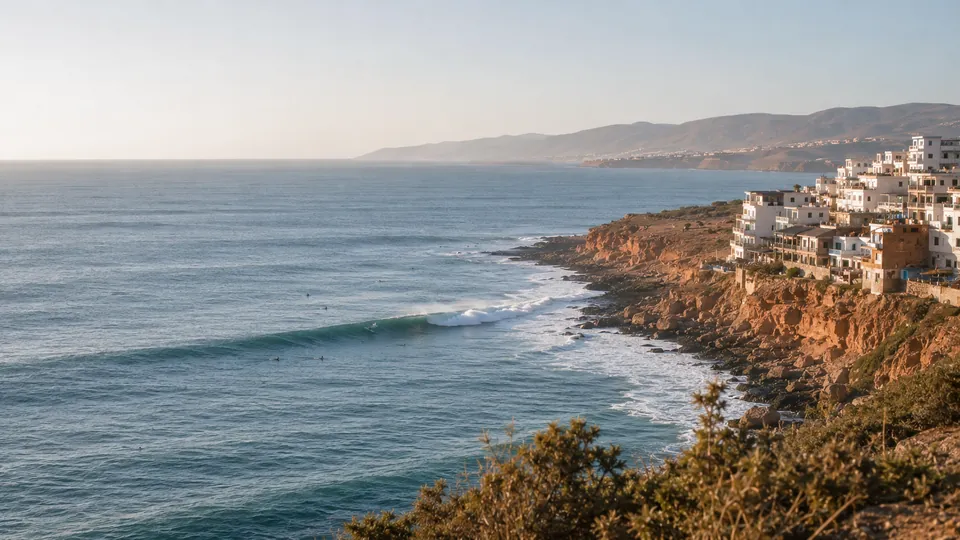
Morocco's reputation rests on waves that are wrong for beginners. Anchor Point, Killer Point, Boilers: all three break over rock, all three start at "advanced". Not knowing that means booking a week on the best-known coast in North Africa and spending seven days in the whitewater while other people surf.
The country is still one of the best places to learn. You only have to know that the beginner waves are not the ones in the photographs.
The breaks that forgive
Of twelve documented breaks on this coast, four are open to beginners.
| Spot | Village | Bottom | Best tide |
|---|---|---|---|
| Banana Beach | Tamraght | sand | high |
| Banana Point | Tamraght | sand | any |
| Devil's Rock | Tamraght | sand | mid |
| La Baie | Imsouane | sand and rock | any |
The column that counts is the bottom. Sand forgives a fall, rock does not. That three of the four are in Tamraght rather than Taghazout is the whole reason most first weeks happen there.
La Baie in Imsouane is the exception: a point, but open from beginner to advanced, with one of the longest rights in Africa. An hour and a half of driving, and worth it.
You do not learn in Taghazout. You sleep in Taghazout and learn five minutes south. That distinction decides the week.
The months that work
| Month | Swell | Period | Water |
|---|---|---|---|
| April | 1.4 m | 11 s | 18 °C |
| May | 1.0 m | 8 s | 19 °C |
| June | 0.7 m | 8 s | 20 °C |
| September | 1.5 m | 11 s | 21 °C |
| January | 2.2 m | 12.5 s | 18 °C |
April is the best month of the year to learn, and the data says so plainly: 1.4 m at 11 seconds over sand is exactly the wave that pushes without punishing. May is second, with lower prices and warmer water.
Coming in January at 2.2 m and 12.5 seconds does not mean you will not surf. It means Devil's Rock and Imsouane bay are your entire map, and a camp that takes you anywhere else is the wrong camp.
How to spot a camp built for beginners
Three questions, and the answers sort in two minutes.
- "Where do you take beginners, by name?" Anyone who cannot name a break does not have one.
- "How many students per instructor?" Six is a reasonable ceiling. The legal frame in Morocco is twelve, and twelve is a queue.
- "What do you do if the swell comes up?" The right answer is a named fallback to the south, not a cancelled day.
What you do not need
Not your own board. A softboard on the spot is the better tool for a first week, and the hold supplement costs more than the hire.
Not a thick wetsuit. Between 17 and 22 °C a 3/2 mm covers the year, a shorty in summer. Camps hire both.
No prerequisite except swimming. It is the one non-negotiable condition, and it is meant seriously.
Frequently asked
How long until I stand up?
In a coached week in the right conditions, most people stand. Standing and surfing are two things, and the second takes seasons.
Seven nights or five?
Seven. Five is two days settling in and three in the water: you leave having barely started.
Taghazout or Tamraght?
For a fully beginner week, Tamraght: the sand is at the door. For evenings and village life, Taghazout, with a five-minute shuttle. Camps run both ways.
The breaks are in the Taghazout guide, the months in the seasons guide, and the houses on surf camps in Tamraght.