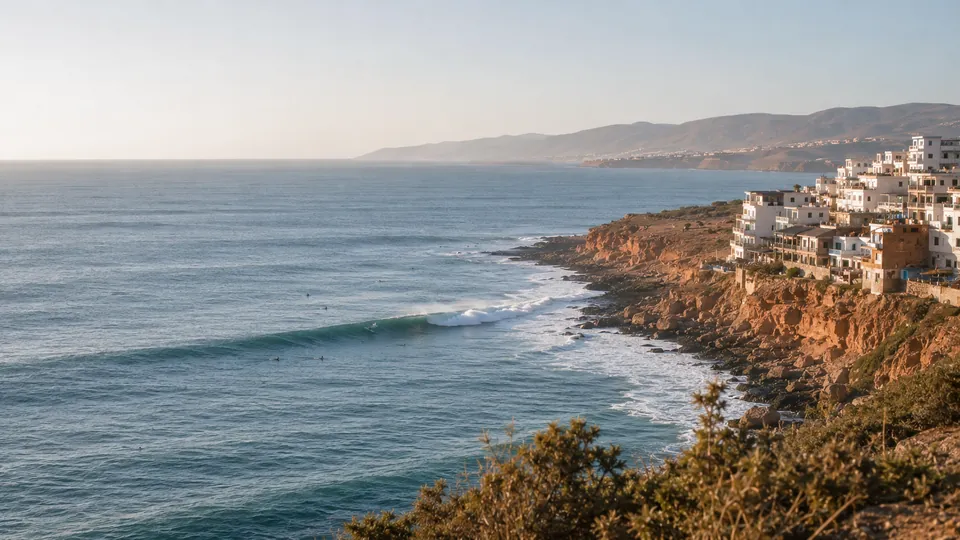
Déca Plage is a sand beach at the eastern end of Aïn Taya, about thirty kilometres east of Algiers, with a pine wood at its back. In summer it is a family beach with lifeguards and umbrellas. In winter, when a low parks itself south of France, it turns into one of the best beach breaks in Algeria, and one of the few where you will find anyone in the water.
There is no surf camp and no school based here, and nobody books a week around it. You go because you are passing through Algiers, or because you want to surf a coast that almost no visiting surfer has ever paddled out on.
The wave
Sandbanks, peaks breaking both left and right, and short, hollow waves: under fifty metres of ride, then the shore. The beach shelves steeply, so the wave stands up suddenly and breaks hard. On an average day an intermediate surfer will have fun. Once the swell is above a metre and a half it belongs to experienced surfers, and it holds up to three metres and beyond.
It needs a north, north-west or north-east swell. Below a metre, nothing happens.
The tide barely matters, which surprises anyone used to the Atlantic: in the Mediterranean it is measured in tens of centimetres. What makes or breaks a session is the wind, and how long the swell lasts.
A swell born next door
The swell at Déca does not cross an ocean. It comes from the mistral: when a low deepens over the Gulf of Lion, the north-westerly blows some seven hundred kilometres down the Mediterranean and lands on the Algerian coast. That gives it two traits:
- very short periods, sometimes three or four seconds between waves. The line-up is choppy, sets arrive close together, and you will spend a lot of time duck-diving;
- short windows. A mistral swell lasts a day or two, is hard to forecast, and can die as fast as it arrived. Cold European air colliding with warm African air makes the Mediterranean notoriously difficult to call, even for people who have surfed it for years.
Over a week in January, expect one swell, sometimes two, with flat days in between.
When to go
November to February. That is when lows track across the western Mediterranean, and the only time Déca properly wakes up.
In summer the swell disappears and an easterly wind sets in. The beach goes to windsurfers, kiters and the Algiers holiday crowds. If there is a small wave, surf it early, before nine, ahead of the wind and the swimmers.
Water and wetsuit
| Month | Water | Wetsuit |
|---|---|---|
| November | 19 to 20 °C | 3/2 mm |
| December | 17 °C | 3/2 or 4/3 mm |
| January | 15 °C | 4/3 mm |
| February | 14 to 15 °C | 4/3 mm, boots if you feel the cold |
January and February are the coldest months of the year and also the ones that bring swell. Midday air stays mild, around sixteen or seventeen degrees, but getting out of the water on a mistral morning is a shivering business.
Who is in the water
A handful of Algiers surfers who all know each other and turn up here the moment the forecast lights up. The mood is friendly, and a visitor with a board is more of a curiosity than an intruder. Gear is hard to come by in Algeria: most of the boards and wetsuits in the line-up were bought abroad and carried home in a travel bag.
This small crew produced Khaled Zirour, a multiple Algerian champion and the country's first sponsored surfer, who now runs a surf school on Nusa Lembongan in Indonesia. And not long ago Dihya Nasri, a vet and national-team swimmer, was thought to be the only woman surfing in the whole country.
In La vie d'Abdèle, a French novel by Izza Amar, the heroine is two Kabyle sisters at once: one leaves for France at eighteen, the other stays. With a board, Abdèle would not have had to choose. At Déca you head out to sea every morning and always come home. And she would have doubled the number of women in the line-up.
Around Déca
Déca has company along this stretch. The beaches of Aïn Taya run one into the next for a few kilometres, and when one closes out, a neighbour may be working:
- Les Canadiennes (Terfaya beach), right next door, another beach break of the same family;
- Surcouf (Aïn Chorb), between Déca and Tamaris, where the sand is mixed with rocks and a rock shelf;
- Tamaris, the big town beach in the middle of Aïn Taya.
On flat days Cap Matifou is close by, with the Roman ruins of Rusguniae near Tamentfoust. Algiers and its Casbah are half an hour away by car, outside rush hour.
Further east, Kabylie and the coast around Béjaïa have their own breaks, Boulimat and Tichy first among them, plus dozens of points with no road to them that light up on big mistral swells. That is a separate expedition, several hours' drive away.
What to bring
- Your own board and wetsuit. There is no reliable rental here.
- A visa, required for UK, US, EU and Swiss passport holders. You apply through the consulate with a booked address to stay at, and it takes time: do not leave it to three weeks before you fly.
- A local contact if you can find one. Algiers surfers are welcoming, and they are the ones who will tell you which day the swell is really arriving.
- Flexible dates. Coming for Déca means surfing only on the days the Mediterranean allows it.
Frequently asked questions
Is it a good spot for beginners?
No. The wave breaks hard on a steep beach, short periods keep the line-up choppy, and there is no school or instructor based here. For a first surf week in North Africa, Morocco wins on every count: Taghazout has learner beaches, camps, and Atlantic swell that does not stop after two days.
Can I plan a guaranteed surf week there?
Not really. Even in midwinter, a week at Déca might give you only one or two days of real waves. It suits someone already in Algiers, or someone happy to gamble on the weather.
Do I need a car?
It makes life easier. Aïn Taya is about thirty kilometres from central Algiers, on the airport side of the city, and the beaches are a few minutes apart by road.
Are there any particular hazards?
The bottom is sand, with no reef. The currents are what need watching, especially in a short, strong swell when the sets come with no lull between them. Go with someone.