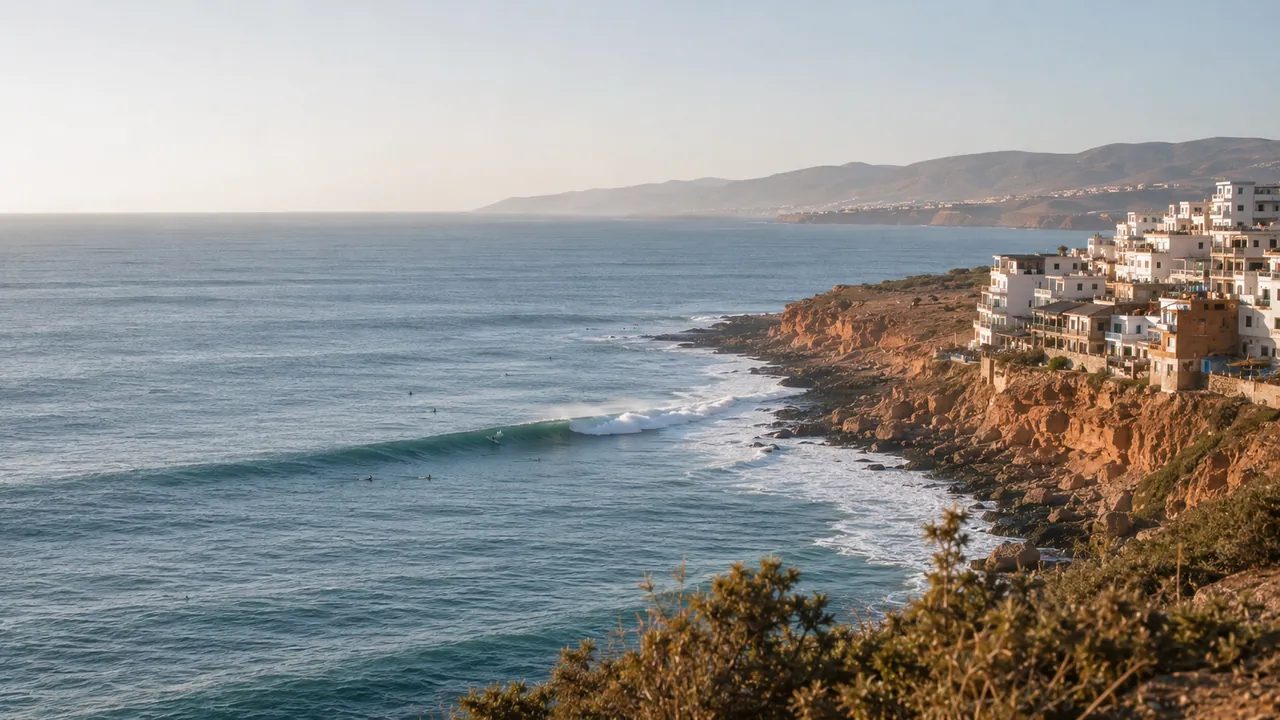
Surfing in Morocco in July

Surfing in Morocco in July

July is the summer paradox: crowds and prices at their summer high, and the poorest surf of the year for anyone past their first week.

  • Swell
    0.7 m, 8 s
  • Water temp.
    20 °C
  • For learning
    Good

Conditions in July

  • Swell : 0.7 m
  • Period : 8 s
  • Water temp. : 20 °C
  • Wetsuit : 3/2 mm fullsuit
  • Air temp. : 27 °C
  • Sunshine hours per day : 8.2 h
  • Rain : 0.2 mm, 0 days
  • Workable wind : 45 %
  • Crowds : High
  • Prices : High

July is the month to look at squarely. The European school holidays fill the villages and push crowds and prices back up to high, the level of January, at the very moment the surf is at its poorest for anyone past beginner. The swell sits at its yearly floor, 0.7 m on average and short, and the north wind of summer blows through most afternoons. No other month charges as much for as little wave.

It is still a good month for one kind of week. Counting the clean days, a surfable swell with no wind on it, Banana Beach in Tamraght gives four in a week and Devil's Rock three: small, clean surf in the morning, soft enough for a first lesson. For a beginner, a family, or a holiday that includes a little surfing, July works, in 20°C water with the air at 27°C and no rain at all.

For anyone who surfs points, it does not. Killer Point, Cathedral Point and Banana Point may not give you a single clean morning all week, and Boilers gives one; the north wind spoils all four far more often than the swell fails. Hash Point, the sheltered break at the top of Taghazout, manages two days, and on the others no swell gets that far in.

An experienced surfer with July dates should look at another coast, where the season is running. If the family holiday is in Morocco anyway, book it as a holiday: the children in a morning lesson on the sand, the afternoons at the beach or the pool, and any session on the points counted as luck. Book early, because most of Europe has the same dates.
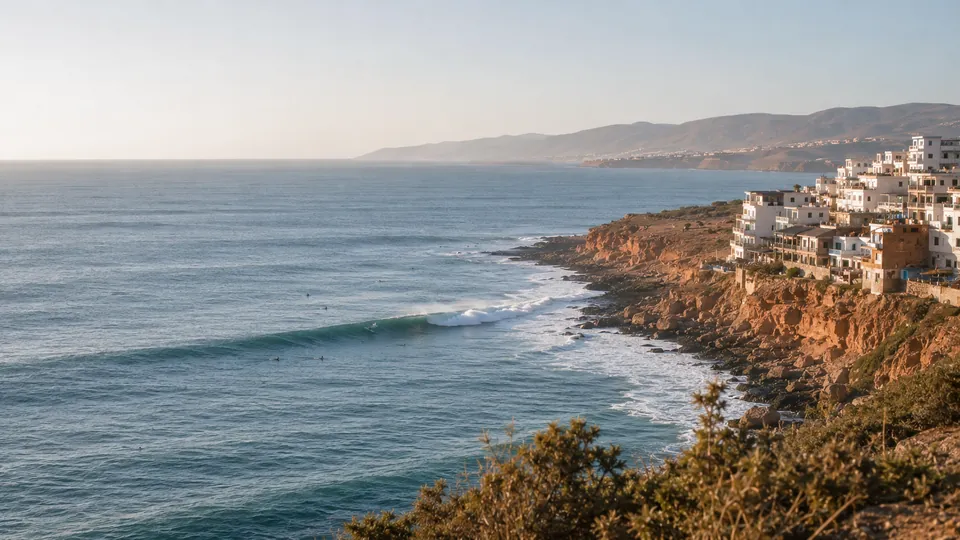
Learning in July

  • For learning : Good

A beginner in Tamraght in July gets more clean days than most people expect of summer: Banana Beach runs clean four days out of seven, and Devil's Rock three. What makes the month harder has nothing to do with the waves on those days. Crowds and prices are at their summer high, the schools are running their biggest groups of the year, and the summer wind takes two or three days of each week at the beach. The waves themselves are small and short-period, easy to stand up on and short of push once you are standing.

The day starts early. Lessons go in the morning, before the north wind fills in, and the afternoon is for the beach, the shade, and the pool if your camp has one. The water is 20°C, a 3/2 full suit, and the air 27°C; it does not rain in July. Banana Beach, the right-hand break at the river mouth, is best at high tide and has real rips, which is why every school in the valley takes its groups there with instructors in the water. Devil's Rock, a sandbar of lefts best around mid-tide, is quieter and has nothing sharp under it: if your group is large, ask to be taken there instead.

For a family the village to book is Tamraght: quiet enough to put children to bed early, under half an hour from Agadir airport, and camps from 34 € a night. For a solo traveller the evenings in Taghazout are livelier, five minutes up the road, and its communal camps are where people who arrive alone meet the rest of the week's group. If your dates are free, June has the same waves with low crowds and low prices, and May is the easiest month of the year to learn in. If July is the only week you have, it is a perfectly good week to learn in; book it early, because everyone else has the same dates.

Where a beginner goes in July

These spots are reachable all year. What the month changes is the size of the waves, not the access.

For an experienced surfer

  • Surf : Off season

There is no July week on the Taghazout points for an experienced surfer, and it is better to know before the flight than after. Killer Point, Cathedral Point and Banana Point can each go the whole week without a single clean session, and Boilers gives one day out of seven. What takes the rest is the north wind: almost every day at Boilers has enough swell and too much wind. Hash Point, which the wind cannot reach, gives two days and loses the others to a swell too small to get into the village.

The swell is at its yearly floor, 0.7 m and short. Anchor Point needs a winter swell to break and does not get one. What is left is a longboard and a dawn start: the Tamraght sandbars before the wind, where the waves are small and clean on three or four mornings in seven, or the long right of La Baie at Imsouane. The water is 20°C, the air 27°C, and the villages are full, because the European holidays have arrived and brought prices back up to their winter level. It is a pleasant place to be and a frustrating one to surf at your level, and a week spent waiting for a swell that the season does not send is the most expensive way to find that out.

If you choose your destination by the surf, go where the season is; in July that means a long-haul flight. If July in Morocco is fixed, most likely by a family holiday, sleep in Taghazout, where camps run from 21 € a night and Hash Point is a walk away for the two mornings a swell reaches it. Be there early on those mornings: everyone in the village can walk to it, and everyone does. The points wake again in September, and by October Boilers gives three days in a week.

  • Beginner

Where to base yourself

Taghazout

Questions about July

  • Is July a good month to surf in Morocco?

    Only for beginners. In July Morocco has its smallest swell of the year and the Taghazout points rarely break cleanly, while the sand at Banana Beach in Tamraght still gives small, rideable waves on about four mornings a week. Camps are full and charging their summer rates.

  • Is Morocco busy in July?

    Yes. European school holidays start in July, and crowds and camp prices along the Taghazout coast climb back to the same level as mid-winter. Book early if your dates are fixed, and consider June for the same small surf with far fewer people.

  • Is Morocco good for a family surf holiday in July?

    It works well if the surfing is for the children or the novices in the family. Tamraght has two sandbars, Banana Beach and Devil's Rock, within walking distance, lessons run in the morning before the wind, and the sea is about 20°C in July. Rain is almost unheard of.

  • Where should an experienced surfer go instead of Morocco in July?

    To a coast in season. In July Costa Rica, Nicaragua, Sri Lanka, Mozambique and South Africa are all at their own peak, while the Morocco points around Taghazout are close to flat or blown out most days. Of the five, Costa Rica has the warmest water, near 29°C.

Where these figures come from

Air, rain and sunshine: WMO / NOAA 1991-2020 normals. Taken at Agadir Al Massira, some twenty kilometres inland and so a little warmer than the coast in summer. Swell, period and share of workable wind: Swell Archive and surf-forecast. Water temperature: seatemperature.org and weather-and-climate. Crowds and prices are an editorial judgement, not a measurement.

Join the Bookawave adventure

Get our exclusive guides, good deals and surf trip inspiration.

No spam, just surf.